

Quick Answer: Fall maintenance on a Northern Virginia rental comes down to five jobs: service the heating system, clear the gutters and check drainage, seal the obvious air leaks, shut off and drain the exterior spigots, and replace smoke and carbon monoxide detector batteries. Done in October, that list runs a few hundred dollars. Skipped, it turns into emergency-rate calls in January, and emergency rates in this market are not small.
Here’s a scenario we see too often. An owner got a call from his tenants late one weekend evening in the winter. His tenants had no heat, the overnight low was 19 degrees, and the furnace had a cracked heat exchanger. When he finally got someone out there, the bill was roughly three times what the same repair would have cost on a regular morning in October, and that is before you count the two nights the family spent in a hotel.
Here is the part that’s important. The furnace had thrown a warning during the previous winter. Nobody followed up on it, because by March it was warm again and the problem went away on its own.
That is how almost every winter emergency we handle actually starts. Not with a surprise. With a small thing that got postponed until the weather made it expensive.
Why October Is the Real Deadline
Northern Virginia usually gets its first hard freeze somewhere in the first half of November, though it moves around year to year. That matters less than the other calendar: HVAC companies book up. By the second week of November, the good ones in Fairfax and Loudoun are running two to three days out on non-emergency service, and once the first cold snap hits, everybody who ignored their furnace calls at once.
So October is not when you should start thinking about this. October is when it should already be done.
What Should Be on the Heating System Check?
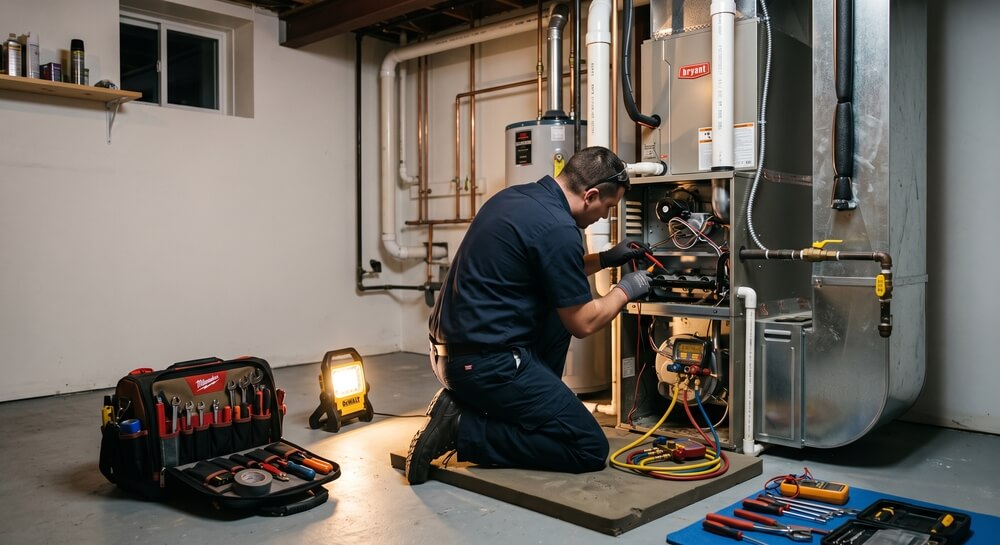
An annual service call on a residential system usually runs somewhere in the low hundreds in this market, and it is the single highest-return maintenance dollar you will spend on a rental. A decent tech will:
- Replace or check the filter, and tell you what size the unit takes so you can hand that to the tenant
- Inspect the heat exchanger for cracks, which is the safety item that matters most on gas systems
- Check the flue and venting
- Test the thermostat and confirm it is actually calling for heat correctly
- Clean the burners and check the ignition system
- Check refrigerant lines and the outdoor unit if it is a heat pump
Ask for the written report. Not just a verbal all clear. A written report is what tells you whether the system is fine, fine for now, or quietly on a countdown, and that difference drives whether you should be budgeting for a replacement in the next capital planning cycle.
If the unit is over fifteen years old, ask the tech directly what they would do if they owned it. Most will tell you straight. And if the answer is that it has a couple of winters left, you want to know that in October when you can shop it, not in January when you are replacing under duress at whatever price is available.
A note on heat pumps
A lot of the townhouse and condos across Reston, Herndon, and Ashburn run on heat pumps with electric backup. Tenants call these in as broken constantly, because a heat pump blows air that feels cool compared to a gas furnace and because the backup strips kick on with a burning smell the first time they run each season. Neither is a defect.
Get ahead of it. A short note to the tenant in early November explaining both saves you two service calls a winter.
Gutters: Yes, For Sure.
This is the job owners most want to skip and the one that causes the most expensive damage. Clogged gutters in a freeze-thaw cycle back water up under the shingles and into the fascia. By the time anybody notices, you are not paying for a gutter cleaning. You are paying for roof repair and drywall.
The timing question people get wrong: if the property has mature oaks or maples, one cleaning in early October is not enough, because most of the leaves have not fallen yet. Schedule it for late October or early November, after the drop. On heavily wooded lots, and there are a lot of those in Vienna, Great Falls, and the older parts of Reston, budget for two visits.
While someone is up there, have them confirm the downspouts actually discharge away from the foundation. Extensions get kicked loose by mowers all summer. A downspout dumping directly against a foundation wall is one of the most common causes of the basement moisture complaints we field in spring.
The Exterior Water Shutoff Nobody Thinks About
Every hose bib on the property needs to be shut off at the interior valve and drained. If the property has an irrigation system, it needs to be blown out by someone with a compressor, not just turned off at the controller.
A burst pipe behind an exterior wall is the single most destructive thing that happens to rental properties in this region in winter. It is also almost entirely preventable with about twenty minutes of work in October.
If the property has a frost-free spigot, it still needs the hose disconnected. A hose left attached defeats the frost-free design entirely, which is a detail that surprises a lot of owners.
Air Sealing: The Cheap One With Real Return
You are not going to re-insulate an attic in October. But there is a short list of low-cost items that measurably reduce heating cost and, more to the point for a landlord, reduce the odds of a tenant complaint about a cold room:
- Replace failed weatherstripping on exterior doors
- Caulk the obvious gaps around window trim and where pipes penetrate exterior walls
- Check that the attic hatch actually seals
- Reverse ceiling fans to clockwise so they push warm air down instead of creating a draft
On a tenant-occupied property this matters for a reason beyond comfort. If a tenant is paying a heating bill that feels punitive, that shows up in the renewal conversation. It is a lot cheaper to caulk a window than to turn over a unit.
Smoke and Carbon Monoxide Detectors
Under Virginia law, the landlord is responsible for maintaining smoke detectors in working order and must service them within a reasonable time after receiving written notice from the tenant. Carbon monoxide detectors carry a similar obligation on request.
Do not wait for the written notice. Fall is the natural moment to swap batteries in every detector in the house, and it costs almost nothing. It is also worth confirming the detectors themselves have not aged out. Most smoke detectors have a ten-year service life stamped on the back, and a lot of the ones we find in properties that have not turned over recently are well past it.
This one is not just about liability. It is the item on the list where the downside is not measured in dollars.
What You Can Skip
We are not going to pretend everything is urgent. A few things get sold hard in the fall that we would not spend on for a typical single-family rental in this market:
- Duct cleaning as an annual service. Useful occasionally, particularly after a renovation, but not a yearly line item
- Full chimney sweeping on a fireplace the tenant does not use. Confirm usage first, then decide
- Whole-house humidifier service on a system that does not have one, which sounds obvious but gets quoted anyway
- Gutter guard upsells pitched during a routine cleaning. Sometimes worth it, but not a decision to make on the spot with a crew standing in the driveway
How Do You Get This Done From Out of State?
A meaningful share of the owners we work with are not in Virginia. Some are not on this continent. The mechanics of fall maintenance change when you cannot drive by and look at the gutters yourself.
Three things make it work. First, bundle the visits so one trip covers as much as possible rather than scheduling five separate trades. Second, require photo documentation from every vendor, before and after, which is standard for the vendors we use and should be standard for yours. Third, decide your approval threshold in advance and put it in writing, so a vendor standing in the crawlspace at 4pm on a Friday is not waiting on a time zone to answer an email about a two hundred dollar repair.
That last one sounds like a small administrative detail. It is the difference between a maintenance issue resolved the same day and one that sits over a weekend and gets worse.
The Short Version
Heating serviced with a written report. Gutters cleared after the leaves actually fall, downspouts discharging away from the foundation. Exterior water shut off, drained, hoses disconnected, irrigation blown out. Weatherstripping and caulk where it has failed. Fresh batteries in every detector, and detectors themselves replaced if they are past ten years.
That is the whole list. It is not complicated and it is not expensive relative to what it prevents. It just has to happen before the weather makes it someone else's schedule instead of yours.
Frequently Asked Questions
When should I schedule furnace service for a Northern Virginia rental?
Early to mid October. HVAC companies in Fairfax and Loudoun start running behind by the second week of November, and once the first cold snap arrives you are competing with every other deferred service call in the region.
Who is responsible for changing HVAC filters, the landlord or the tenant?
It depends entirely on what your lease says. Many Northern Virginia leases assign filter changes to the tenant, so make sure the tenant knows the filter size and where the return is.
Do I need to clean gutters if the property has gutter guards?
Usually yes, just less often. Guards reduce debris but do not eliminate it, and they can create their own problem when fine debris packs in underneath. Have them inspected annually even if you skip a full cleaning.
What happens if a pipe bursts because exterior water was not shut off?
Practically speaking, It depends on your lease. The leases we have state it is the tenant's responsibility, and if they do not take the necessary measures, it will be their responsibility if a pipe bursts. We provide instruction and documentation on exactly how they should do this.